
Sensorineural hearing loss is one of the most common types of hearing loss. It happens when the inner ear or the hearing nerve gets damaged. It can affect one ear or both ears and may develop slowly or suddenly.
The symptoms of sensorineural hearing loss are easy to miss in the beginning. Learning these signs can help you get the right diagnosis and treatment at the right time.
In this guide, Dr. Purodha Prasad, an ENT Specialist in Delhi, explains the symptoms of sensorineural hearing loss, its causes, diagnosis, and treatment in simple language.
Before understanding the symptoms of sensorineural hearing loss, it is important to know what this condition actually is and why it happens.
What Is Sensorineural Hearing Loss? Dr. Purodha Prasad Explains
Before learning about the symptoms of sensorineural hearing loss, let us understand what is this condition ?
Sensorineural hearing loss happens when the inner ear or the hearing nerve gets damaged. Because of this, sound cannot reach the brain properly. As a result, hearing becomes less clear, and understanding words becomes difficult.
Sensorineural hearing loss can affect people of any age. It can happen because of growing older, loud sounds, viral infections, some medicines, family history, or certain health problems. It may affect one ear (unilateral sensorineural hearing loss) or both ears (bilateral sensorineural hearing loss).
According to Dr. Purodha Prasad, knowing the symptoms of sensorineural hearing loss can help you get the right diagnosis and treatment at the right time. If you notice any changes in your hearing, it is best to visit an ENT specialist.
Once you understand what sensorineural hearing loss is, the next step is to know how the symptoms change at different stages. It usually starts with mild signs that are easy to ignore.
Concerned About Your Hearing?
Don’t ignore the symptoms of sensorineural hearing loss.
Book a hearing evaluation with Dr. Purodha Prasad, ENT Specialist in Delhi.
Symptoms of Mild Sensorineural Hearing Loss
People with mild sensorineural hearing loss can usually hear most everyday sounds. However, they may start noticing small changes in their hearing. These changes are easy to ignore because they develop slowly over time.
According to Dr. Purodha Prasad, identifying the symptoms of mild sensorineural hearing loss early can help prevent further hearing problems. If you notice any of the following signs, it is a good idea to visit an ENT specialist for a hearing check-up.
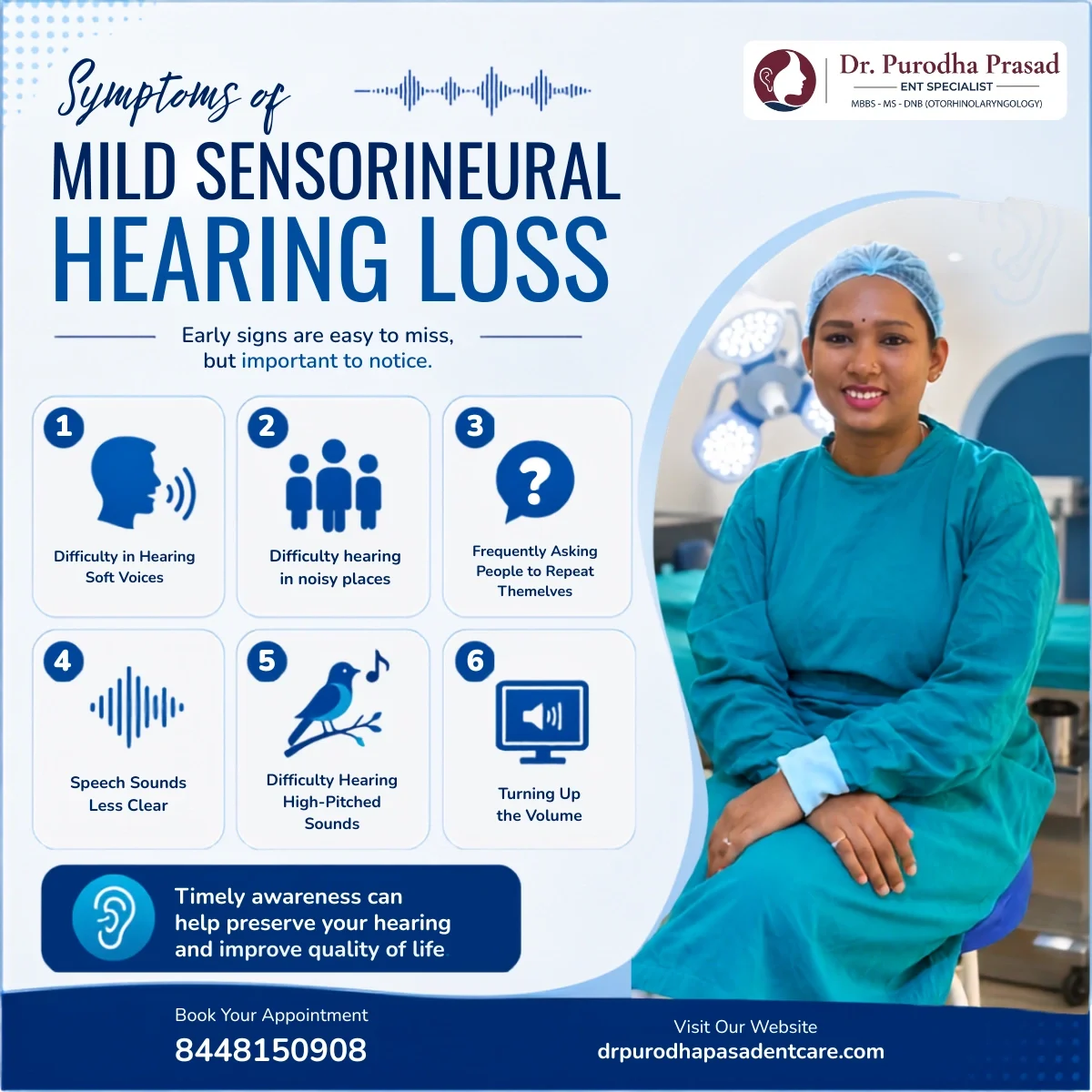
- Difficulty in Hearing Soft Voices: People who speak calmly, children, or someone calling from another room may become difficult to hear. You may find yourself asking others to speak louder without realising that your own hearing has become worse.
- Difficulty Hearing in Noisy Places: Talking in crowded restaurants, offices, or family gatherings may become difficult. Even if you can hear people talking, it can be hard to understand their words because of the background noise.
- Frequently Asking People to Repeat Themselves: Do you usually find yourself saying, “What?” or “Can you repeat that?”, especially when someone speaks quickly? This is one of the early symptoms of mild sensorineural hearing loss.
- Speech Sounds Less Clear: Even if the volume is loud enough, words may not sound clear. According to Dr. Purodha Prasad, many people notice this change before they realise that their hearing has become weaker.
- Difficulty Hearing High-Pitched Sounds: High-pitched sounds such as bird chirps, phone notifications, or female voices may become difficult to hear. At the same time, lower-pitched sounds may still sound normal.
- Turning Up the Volume: You may slowly start increasing the volume on your phone or television to hear conversations clearly. At the same time, your family members may feel the volume is already too loud.
If mild hearing loss is not identified early, the problem can become more noticeable. Here are the symptoms you may experience as hearing loss becomes moderately severe.
Symptoms of Moderately Severe Sensorineural Hearing Loss
When sensorineural hearing loss becomes moderately severe, everyday conversations become much more difficult. You may find it hard to understand what people are saying, even in a quiet place. At this stage, hearing problems can start affecting your daily life.
According to Dr. Purodha Prasad, these symptoms of moderately severe sensorineural hearing loss should not be ignored. A hearing test can help find the cause of your hearing loss and the right treatment for you.
Here are the common symptoms of moderately severe sensorineural hearing loss:
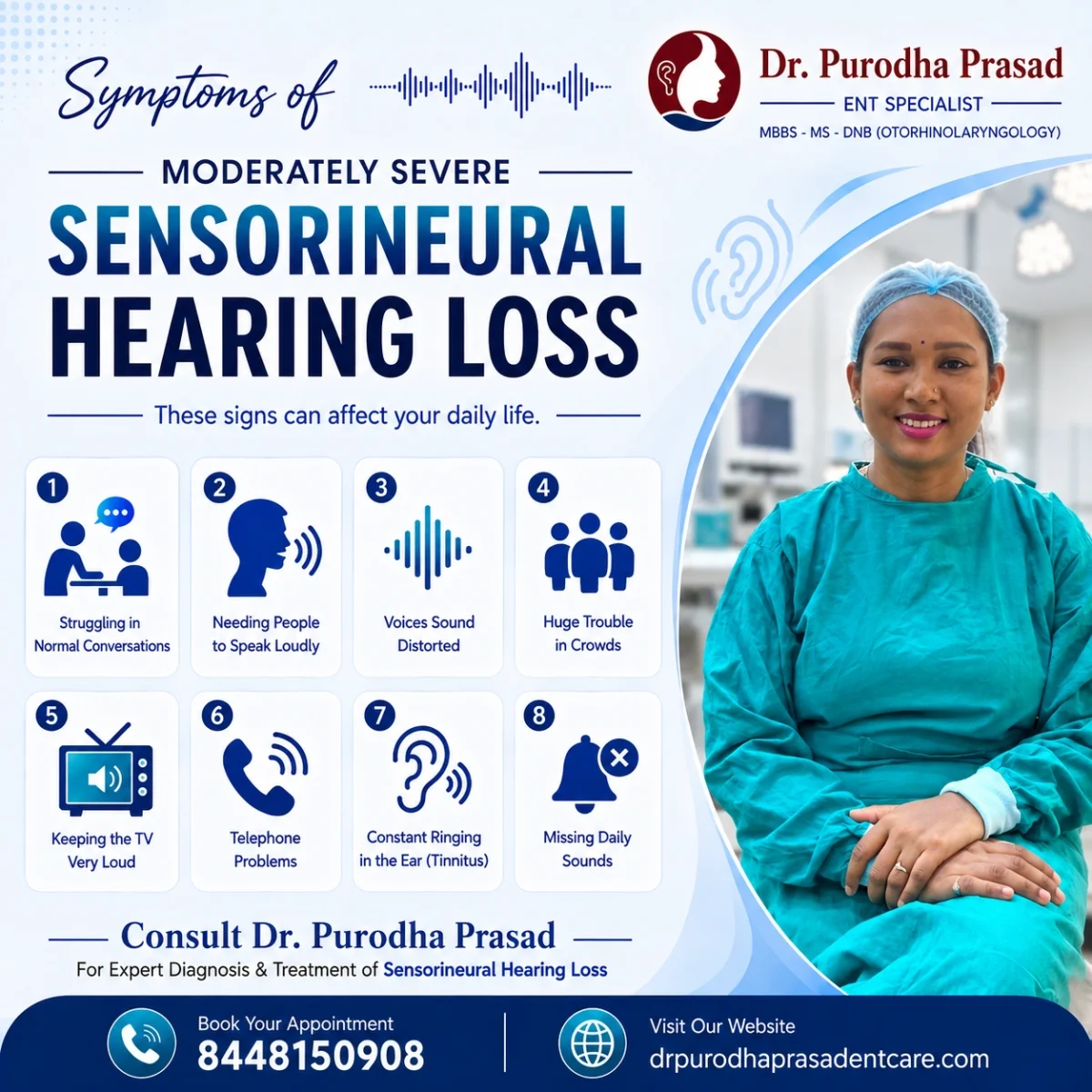
- Struggling in Normal Conversations: Even in a quiet place, you may miss a few words during a conversation. Your family members may have to repeat themselves or speak louder for you to understand them.
- Needing People to Speak Loudly: You may notice that you can hear people only when they speak loudly. Normal conversations may sound too soft or unclear.
- Voices Sound Less Clear: Words may sound quiet, unclear, or difficult to understand. According to Dr. Purodha Prasad, this happens because damage to the inner ear affects how clearly you hear the speech.
- Trouble Hearing in Crowded Places: Restaurants, family functions, meetings, or other crowded places may become difficult because of the background noise. Following a conversation can become a real challenge.
- Keeping the TV Very Loud: You may need to increase the volume on your television, mobile phone, or music system to hear clearly. At the same time, your family members may feel the volume is already too loud.
- Telephone Problems: Talking on the phone may become difficult, especially if you do not know the person’s voice. You may start using speaker mode or asking people to repeat what they said.
- Constant Ringing in the Ear (Tinnitus): You may hear ringing, buzzing, humming, or whistling sounds in one or both ears. These sounds may affect your daily activities or make it difficult to sleep.
- Missing Everyday Sounds: You may stop noticing everyday sounds that you could hear before. This may include a ringing doorbell, phone notifications, kitchen appliances, or someone calling your name from another room.
Sensorineural hearing loss does not affect only adults. Children can also develop hearing loss, but the signs are usually different and can be difficult to notice.
Symptoms of Sensorineural Hearing Loss in Children
The symptoms of sensorineural hearing loss in children can be different at different ages. Some children are born with hearing loss, while others may develop it later because of ear infections, certain medicines, or other health problems.
Young children may not know that they have a hearing problem. According to Dr. Purodha Prasad, parents and teachers should watch for the early symptoms of sensorineural hearing loss so that the child can get the right diagnosis and treatment as early as possible.
Here are the common symptoms of sensorineural hearing loss in children:
- Delayed Speech Skills: One of the early signs is delayed speech. A child may speak fewer words than expected for their age, pronounce words incorrectly, or have difficulty speaking in complete sentences.
- Ignoring Their Name: A child may not respond when you call their name, especially if you are in another room. Parents may think the child is distracted, but it could be a sign of hearing loss.
- Constantly Saying “What?”: Older children may ask people to repeat what they said. They may often say, “What?” because they cannot hear or understand words clearly.
- Struggling in Class: Teachers may notice that the child does not follow spoken instructions or answers questions incorrectly. The child may need things to be explained again, even though they are able to learn well.
- Loud Screen Time: Children with hearing loss may keep the volume of the television, tablet, or mobile phone much louder than other family members.
- Trouble Hearing in Noisy Places: Children may find it difficult to understand speech in crowded classrooms, playgrounds, birthday parties, or family gatherings where there is a lot of background noise.
- Poor Academic Performance: Hearing loss can affect a child’s learning, reading, concentration, and classroom participation. Some children may look distracted when they are actually having trouble hearing the teacher.
- Missing Everyday Sounds: A child may not notice everyday sounds like a doorbell, phone notification, alarm, or someone calling their name from behind.
- Watching People’s Lips: Some children may start looking at people’s lips or facial expressions to understand what they are saying. They may find it harder to understand conversations when they cannot see the speaker’s face.
- Complaints of Ear Ringing: Older children may complain of ringing, buzzing, or humming sounds in their ears. This is called tinnitus and can be one of the symptoms of sensorineural hearing loss.
Knowing the symptoms is only the first step. To confirm the problem and understand how much hearing loss is present, your ENT specialist may recommend a hearing test.
Concerned About Your Hearing?
Don’t ignore the symptoms of sensorineural hearing loss.
Book a hearing evaluation with Dr. Purodha Prasad, ENT Specialist in Delhi.
Pure Tone Audiometry for Sensorineural Hearing Loss in Delhi – How Does It Help?
If you have the symptoms of sensorineural hearing loss, your ENT specialist may recommend a Pure Tone Audiometry (PTA) test. It is a simple and painless hearing test that checks how well you can hear different sounds and pitches.
The PTA test helps your doctor understand the type and severity of your hearing loss. According to Dr. Purodha Prasad, this test is an important step in finding the right diagnosis and treatment.
Here are the benefits of a Pure Tone Audiometry test:

- Confirms the Exact Problem: The PTA test helps your ENT specialist find out whether your hearing loss is caused by a problem in the inner ear or the hearing nerve. It also helps confirm if you have sensorineural hearing loss.
- Measures the Severity: The test shows whether your hearing loss is mild, moderate, moderately severe, severe, or profound. This helps your doctor plan the right treatment for you.
- Checks One or Both Ears: The test shows whether the hearing loss is present in one ear (unilateral sensorineural hearing loss) or both ears (bilateral sensorineural hearing loss).
- Evaluates Sound Frequencies: Some people hear low-pitched sounds better than high-pitched sounds. The PTA test shows which sounds are difficult for you to hear.
- Helps Find the Type of Hearing Loss: The PTA test helps your ENT specialist understand whether your hearing loss is sensorineural or conductive. This is important for choosing the right treatment.
- Helps Plan Your Treatment: According to Dr. Purodha Prasad, the PTA test results are reviewed along with your symptoms and ear examination. Based on the results, your doctor can decide whether you need medicines, hearing aids, hearing therapy, or more tests.
If you notice any of these symptoms of sensorineural hearing loss, do not ignore them. Booking an early consultation can help you understand the cause and start the right treatment.
BOOK YOUR APPOINTMENT
Book an Appointment with Dr. Purodha Prasad
For Expert Diagnosis & Treatment of Sensorineural Hearing Loss
Conclusion: Take Timely Action for Better Hearing
The symptoms of sensorineural hearing loss can be easy to miss in the beginning. However, finding them early can help you get the right diagnosis and treatment before your hearing becomes worse.
If you notice difficulty hearing conversations, ringing in your ears, or a sudden change in your hearing, do not ignore these signs. According to Dr. Purodha Prasad, an early hearing check can help find the problem and guide the right treatment.
If you are experiencing any of these symptoms, book an appointment with Dr. Purodha Prasad, an ENT Specialist in Delhi, for a complete hearing evaluation and the right treatment plan.
Concerned About Your Hearing?
Don’t ignore the symptoms of sensorineural hearing loss.
Book a hearing evaluation with Dr. Purodha Prasad, ENT Specialist in Delhi.
About Author - Dr. Purodha Prasad, Delhi

Dr. Purodha Prasad (MBBS, MS, DNB – Otorhinolaryngology) is an ENT Specialist in Delhi with more than 10 years of experience in diagnosing and treating ear, nose, and throat conditions. She has a special interest in the diagnosis and treatment of sensorineural hearing loss and other hearing disorders.
Dr. Purodha Prasad is trained in microscopic and endoscopic ear surgery and has experience in managing patients who need hearing aids, cochlear implants, and other advanced hearing treatments. She also carefully evaluates hearing tests such as Pure Tone Audiometry (PTA) and Tympanometry to provide the right diagnosis and treatment.
She has received advanced medical training in Italy and combines international experience with modern ENT care. Dr. Purodha Prasad consults at Vanya Clinic (Aesthetics & ENT) in South Delhi, where she provides diagnosis and treatment for hearing loss and other ENT conditions.
If you are experiencing the symptoms of sensorineural hearing loss, Dr. Purodha Prasad can help you understand the cause of your hearing problem and recommend the most suitable treatment based on your condition.
Address :
Vanya Clinic – Aesthetics & ENT Green Park, New Delhi | Sinus, Hearing & Throat Care in Delhi,
F 14, ground floor, green park extension near Green park extension market, South, Green Park Extension, New Delhi, Delhi 110016